Translating Strategy into Educational Practice: How the SECOVE Project updated 10 European curricula
Bridging the gap between policy and educational provision
The ongoing European transition towards a climate-neutral, circular, and digital economy represents a significant structural shift across industrial sectors. Achieving the policy objectives outlined in the European Green Deal and adapting to rapid technological advancements requires a workforce equipped with relevant, up-to-date competencies. Consequently, high-level strategic goals must be supported by responsive educational interventions capable of addressing emerging labour market demands. The SECOVE project was established to facilitate this process by aligning Vocational Education and Training (VET) and Higher Education offerings with Regional Smart Specialisation Strategies (RIS3).
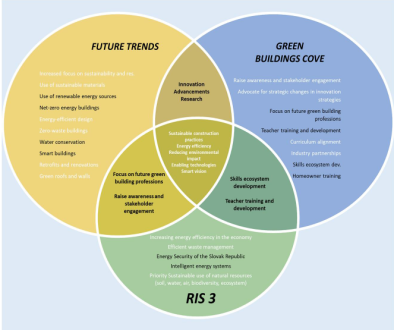
A foundational element of the SECOVE project was the research and analysis compiled in Deliverable 3.2, ”Recommendations for alignment of VET courses to Smart Specialisation Strategies (RIS3)“. This comprehensive report provided an assessment of the existing educational landscape across the consortium’s partner countries (Greece, Italy, Spain, Slovakia, and Portugal). It mapped regional educational ecosystems against local and national innovation priorities, identifying structural skills gaps and outlining recommendations for modernising VET and Higher Education programmes. The report emphasised the need for continuous curriculum updates, the integration of digital technologies, the incorporation of green competencies, and the development of closer cooperation with industry.
Following these strategic guidelines, the partner institutions initiated a structured process to review, enrich, and update their educational offerings. The result of this collaborative effort is the successful update of 10 distinct curricula, spanning from secondary vocational training to advanced university master’s degrees. These updates reflect a practical implementation of the project’s analytical findings, demonstrating how strategic research can be systematically transformed into relevant educational pathways that support the sustainable energy sector. This article provides an overview of how these 10 curricula were modernised,detailing the integration of digital technologies, green skills, and industry-oriented methodologies across the partner institutions.
Developing flexible competencies for the Green and Circular economy
One of the primary areas identified for improvement in the regional reports was the need for specialised training in renewableenergy systems and circular economy practices. The analyses highlighted that traditional, multi-year educational frameworks require time to adapt, creating a temporary skills deficit in fast-moving green sectors. To address this, modern training systemsmust offer flexible, short-term programmes designed to upskill professionals already active in the workforce.
In Greece, the University of West Attica (UNIWA) addressed the structural deficit in training technicians for renewable energy installations and smart grid technologies. Through its Centre of Continuing Education and Lifelong Learning (KEDIVIM), UNIWA developed two targeted VET programmes. The first programme, “Photovoltaic Systems: Applications and Design“, responds directly to the national RIS3 emphasis on renewable energy sources and energy efficiency. Recognising the need for adaptable learning models for adult learners, UNIWA structured this as an intensive 50-hour course delivered oversix weeks. It utilises a blended learning methodology, combining 41 hours of synchronous distance learning with 12 hours ofmandatory physical laboratory sessions. This format allows working professionals to acquire practical competencies in solar energy design and installation without interrupting their employment. By granting 6 ECTS credits and a formal Certificate of Training upon completion, the programme aims to produce the market-ready technicians identified as needed by the localeconomy.
The second UNIWA programme, “Circular Economy: Transition and Strategies“, addresses the shift away from a linear industrial model towards sustainable supply chains and resource efficiency. Designed as a 50-hour, 8-week course granting 5ECTS, it is delivered entirely via distance learning (both synchronous and asynchronous) to maximise accessibility. Thecurriculum covers regulatory frameworks, sustainable business models, and circular supply chain logistics. By tasking learnerswith assessing the linearity and circularity of real-world products and services, the course prepares corporate staff, scientists, andentrepreneurs to identify viable opportunities for implementing circular models within existing enterprises.
Integrating Digitalisation, Smart Technologies, and Immersive Learning
The SECOVE analysis established that the green transition is fundamentally linked to digital transformation. Consequently, updated curricula across the consortium placed a strong emphasis on integrating digital tools, the Internet of Things (IoT), and immersive technologies into standard technical training.
In Spain’s Basque Country, where advanced manufacturing and energy are key regional RIS3 priorities, Politeknika Txorierrideveloped a specialised VET Master in “Digital Transformation in Industry“. Designed in close collaboration with industry partners, the programme connects digital technologies directly with resource efficiency. The curriculum integrates IoT, cybersecurity, data management, and artificial intelligence into practical energy applications. A central feature of this curriculum is its connection with practice through the SECOVE Smart School initiative. An IoT system was installed on the campus to monitor energy and material consumption, and students actively use this infrastructure to configure devices and analyse data, turning the school into a practical learning environment. Furthermore, the programme employs the regional ETHAZI collaborative learning methodology and a dual training system, allowing students to divide their time between the classroom and active industrial company projects.
To ensure that curricula remain relevant and accessible, SECOVE recommendations stressed the necessity of pedagogical innovation and the modernisation of laboratories. In Greece, SAEK DELTA utilised its participation in the project to enrich the delivery methods of five nationally defined technical specialisations: Automation Technician, Technician of Thermal Installations and Gas, Cooling Technician, Technician of Electrical Systems, and Renewable Energy Sources Technician. Within the national framework, the institution introduced Virtual Reality (VR) and simulation-based training. Through five newdigital modules focused on smart buildings, green roofs, smart homes, and solar energy technologies, trainees can practice complex installation and safety procedures in a simulated, repeatable environment. This directly operationalises the SECOVE directive to modernise laboratories and mirror real working conditions.
Similarly, SAEK Egaleo adopted immersive technologies to update its energy-related specialisations, specifically the Renewable Energy Systems Technician and Automation Technician programmes. The institution integrated Matterport technology to create highly realistic virtual models of renewable energy installations and electrical infrastructures. Students can navigate these virtual industrial environments to conduct fault diagnoses, analyse equipment failures, and develop maintenance strategies. This approachcomplements physical laboratory work, increasing the frequency of practical exercises and allowing students to familiarise themselves with authentic workplace conditions. In the Automation modules, greater emphasis was placed on programmable logic controllers (PLCs), industrial communication, smart sensors, and intelligent monitoring solutions characteristic of Industry 4.0 environments. The thematic Maritime Automation Technician programme was also updated to incorporate intelligent vessel automation and digitalmonitoring systems.
Furthermore, SAEK Egaleo incorporated comprehensive revisions to expand the focus on sustainability. New content related to the Circular Economy was introduced, teaching students to consider resource efficiency, waste reduction, material recovery, and lifecycle thinking in their technical planning. The Energy Economics module was substantially updated to cover the financial aspects of energy production, investment analysis, energy markets, policy frameworks, and cost-benefit evaluations, providing a broader socio-economic context for technical engineering decisions.
Modernising sustainable construction and the Built Environment
The construction and building sector is a major focus of European sustainability efforts, adapting to meet new energy efficiency, climate resilience, and digital lifecycle management standards. Educational institutions in Slovakia and Italy utilised SECOVE recommendations to systematically update their civil engineering and construction curricula.
In Italy, CIOFS-FP ETS enhanced the digital dimension of its vocational training in the construction and energy sectors. Respondingto the RIS3 priorities of Lazio and Sardinia, the institution integrated Building Information Modelling (BIM) as a stable and mandatorycomponent of its pathways. Rather than treating BIM as merely an optional software skill, it is now taught as an established referencefor understanding the digital transformation of construction processes. Learners are introduced to a new way of organising information,coordinating sustainable design throughout the building lifecycle, and evaluating the relationship between design and energyperformance. This integration is supported by continuous cooperation with industry experts, who provide technical input and present casestudies.
At the secondary education level, the Secondary Industrial School of Civil Engineering and Geodesy (STAVKE) in Koiice, Slovakia, shifted the focus of its “3650 M — Construction“ study programme. The SECOVE analysis identified a need to expandeducation towards the construction of new green buildings and the adaptation of existing structures. Moving from traditionalconstruction methods to a comprehensive lifecycle approach, the updated educational content incorporates energy efficiency, sustainablematerials, water management, green roofs, circular economy principles, and digital building management. By treating a building as an interconnected system rather than a series of isolated structural components, STAVKE prepares its secondary-level graduates toenter an industry where environmental responsibility is integrated into every phase of a project.
At the higher education level, the Technical University of Koiice (TUKE) integrated SECOVE principles into its existing Civil Engineering courses. The updated curriculum strengthens interdisciplinary topics such as blue-green infrastructure, nature-basedsolutions, energy-efficient buildings, renewable energy integration, and climate adaptation of the built environment. A key practical addition is the integration of the Greenizola Living Lab. This facility enables students to move beyond theoretical studies by actively monitoring green roofs, analysing rainwater management systems, and evaluating energy performance using realenvironmental data, thereby bridging the gap between theoretical engineering and applied sustainable construction.
In Italy, Sapienza University of Rome applied the SECOVE framework to its Master of Science (MSc) in Environmental andSustainable Building Engineering at the Rieti campus. Addressing the Lazio region’s RIS3 focus on the “Energy in Sustainable Building“ partnership, the university restructured a previously fragmented 12-ECTS optional group into two distinct, specialisedtracks: “Construction and Sustainable Building“ and “Environmental and Water Engineering“. This streamlining provides clear,industry-aligned professional pathways. The updated curriculum strategically positioned subjects such as Historic Building Information Modelling (H-BIM) for heritage renovation and project financing for the valuation of green investments. Furthermore, a new courseon “Environmental and Urban Planning in Inner Areas“ was introduced to address the specific regional challenge of managing sustainable development and territorial balance in non-urban, depopulated regions characterised by high natural value.
Fostering industry co-creation and challenge-based learning
A consistent methodological shift observed across the updated curricula is the deepening of relationships between educational institutions and the industrial sector. The SECOVE project highlighted that maintaining the relevance ofprofessional training requires moving from transactional interactions to structured, ongoing collaboration with employers andresearch bodies.
In Portugal, the Instituto Superior de Engenharia do Porto (ISEP), part of Instituto Politécnico do Porto (IPP), updated itsMaster’s in Informatics Engineering to directly address this need. Aligning with the D3.2 recommendation for stronger industry-driven curriculum development, IPP introduced a challenge-based learning component. Master’s students collaborated with five partner companies to address specific challenges in the sustainable energy sector. This hands-on collaborationculminated in the selection of the best completed challenge and the signing of Academia-Industry protocols, establishing thisco-creative process as a structured part of the curriculum.
The knowledge generated through this initiative was subsequently utilised to produce a Massive Open Online Course (MOOC) on sustainable energy. This MOOC has been integrated into an existing curricular unit, providing scalable, flexible digitalresources that complement face-to-face teaching. Furthermore, IPP took a leading role in establishing the Portuguese SECOVE Innovation Hub, designed as a permanent structure linking VET institutions, companies, public entities, and technology partners to ensure the curriculum remains responsive to sector developments.
This emphasis on industry collaboration was adopted across the consortium. SAEK DELTA strengthened its work-based learning components by signing over 20 Memorandums of Understanding (MoUs) with local companies to facilitate internshipsaligned with real labour-market demands. It also established MoUs with 16 international organisations to support transnational student mobility. At Politeknika Txorierri, the dual training system directly involves companies in the learning process, ensuring that educational outcomes remain aligned with industry standards. Similarly, TUKE strengthened project-based learning through the SECOVE Innovation Hub, where students collaborate with researchers and industry partners on realsustainability challenges.
Conclusion
The successful update of these 10 curricula across Greece, Italy, Spain, Slovakia, and Portugal represents a substantive, measurable achievement for the SECOVE project. By mapping educational offerings against Regional Smart SpecialisationStrategies (RIS3) and identifying specific skills gaps through empirical research, the partner institutions were able toimplement targeted, highly relevant curriculum updates.
While these 10 updated curricula span different educational levels, from short-term adult VET courses and secondary technical studies to comprehensive university Master’s degrees, they share a unified methodological approach. They consistently integrate digital tools such as VR, BIM, and IoT; embed green competencies and circular economy principles into technical planning; employ practical, challenge-based learning methodologies; and maintain structured, co-creative collaborations with industry partners.
By systematically translating strategic policy recommendations into tangible educational pathways, the SECOVE consortium has demonstrated a practical framework for aligning professional education with the needs of the green and digital transitions. These modernised curricula ensure that graduates are equipped with the precise knowledge and adaptability required to support Europe’s sustainable energy objectives and contribute effectively to the evolving labour market.