SECOVE — Curriculum Impact at Instituto Politécnico do Porto (IPP)
Over the past four years, the participation of Instituto Superior de Engenharia do Porto (ISEP), part of Instituto Politécnico do Porto (IPP), in the Erasmus+ SECOVE project (Centre of Vocational Excellence in Sustainable Energy) has led to concrete changes in the institution’s curriculum, bringing it closer to the priorities of the Smart Specialisation Strategy (RIS3) for the sustainable energy sector in Portugal, as identified in the project’s deliverable D3.2 for the Portuguese case.
Curriculum changes and additions
> Business collaboration in the Master’s in Informatics Engineering
Within the Master’s in Informatics Engineering, a new challenge-based learning component was introduced in direct collaboration with the business sector. Twenty Master’s students worked with five partner companies to solve real-world challenges in the field of sustainable energy, culminating in an evaluation event with stakeholders and national partners, the selection of the best completed challenge, and the signing of Academia-Industry protocols. This initiative was preceded by a joint workshop with Energaia (with more than 400 entities invited), which strengthened the links between IPP, companies and public entities in the energy sector. This component did not exist before SECOVE and now forms a structured part of the Master’s curriculum, directly responding to the D3.2 recommendation on “Industry-Driven Curriculum Development” and on strengthening collaboration between VET/higher education institutions and industry.
> Integration of sustainability MOOCs into a curricular unit
As a direct result of the work carried out through the challenge with partner companies, a MOOC (Massive Open Online Course) on sustainable energy was produced and has since become part of the curricular content of an existing course unit. Delivering this content in MOOC format complements face-to-face teaching with flexible, reusable digital resources, in line with the D3.2 recommendation on “Technological Integration” and the digitalisation of VET curricula, and ensures the continuity and scalability of learning on energy sustainability for future cohorts of students.
> Strengthening teacher training and pedagogical methodology
A teacher training workshop was organised in partnership with one of the country’s most recognised VET schools, aimed at the SECOVE e-learning course, complemented by the preparation of training for students taking part in the pilot course. The developed course and its pedagogical guidelines were translated and made available on the consortium’s Teams platform, and the IPP team took part in capacity-building activities on VET graduate tracking systems and quality assurance in VET organisations. Together, these actions represent a strengthening of continuous teacher training, in line with the D3.2 recommendation on “Continuous Professional Development for Teachers”.
Establishment of the IPP Innovation Hub for sustainability VET
IPP took a leading role in establishing the Portuguese SECOVE Innovation Hub, designed as a permanent structure linking VET institutions, companies, public entities and technology partners, with the aim of keeping the curriculum up to date with developments in the sustainable energy sector (renewable energy, energy efficiency and smart grids), as identified in the future trends described in D3.2. The Hub also contributes to IPP’s internationalisation objectives, namely through a collaboration agreement with CIOFS-FP ETS for student placements.
Link to the D3.2 findings and guidelines for Portugal
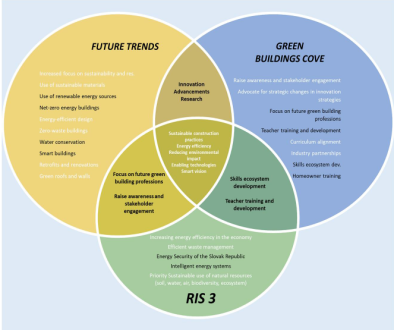
D3.2 found a strong alignment between Portuguese VET/CoVE centres and RIS3 priorities in the sustainable energy sector, while also identifying the need to strengthen collaboration between VET institutions, industry and research bodies, and to integrate emerging technologies and digitalisation into curricula. The changes introduced at IPP, business collaboration in the Master’s in Informatics Engineering, integration of sustainability MOOCs into a curricular unit, teacher training, and the creation of the Innovation Hub, spond directly to these guidelines, constituting concrete examples of the best CoVE practices identified in the report (strong industry collaboration, work-integrated learning, and continuous professional development for teachers).
Contribution to the project KPI
The set of changes described constitutes an updated curriculum in light of the Smart Specialisation Strategies, directly contributing to the project KPI “Increasing the relevance and quality of VET curricula, according to Smart Specialisation Strategies, Number of updated curricula”.