From Strategic Recommendations to Modern Education: How the SECOVE Project Influenced Education at STAVKE
From strategic analysis to transformation of Vocational Education
The transformation of the construction sector towards energy-efficient, environmentally responsible and digitally managed buildings brings new requirements not only for the construction industry itself, but also for vocational education and training. Future construction technicians can no longer be prepared solely for traditional methods of building design and construction. They need to understand energy efficiency, sustainable materials, renewable energy sources, water management, circular economy principles, BIM technologies and the broader context of green buildings.
The SECOVE – Sustainable Energy Centres of Vocational Excellence project created an opportunity for the Secondary Industrial School of Civil Engineering and Geodesy in Košice (STAVKE) to systematically reconsider how vocational education should respond to these changes. One of the important starting points was Deliverable D3.2, Recommendations for Alignment of VET Courses to Smart Specialisation Strategies (RIS3), which analysed the alignment of vocational education with regional and national innovation strategies and identified both gaps and opportunities in the field of green buildings.
As with other SECOVE partners, strategic research therefore did not remain merely a theoretical exercise. For STAVKE, it provided a framework for the gradual modernisation of educational content and teaching approaches, as well as for stronger cooperation with universities, professional organisations and industry.
Addressing the educational gaps identified by SECOVE
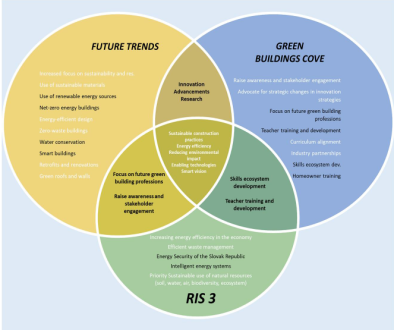
The D3.2 analysis identified a relatively low level of alignment between existing education and training programmes in Slovakia, particularly in the Košice region, and the principles of sustainability, green buildings and national research and innovation strategies. Although the Slovak RIS3 does not include green buildings as a separate priority, energy efficiency, intelligent energy systems, efficient waste management and the sustainable use of natural resources are incorporated into several priority areas.
Within this regional educational ecosystem, D3.2 identified STAVKE as having a particularly important position. The Secondary Industrial School of Civil Engineering and Geodesy was identified as the only school in the Košice region providing education focused on the implementation of construction projects within the 3650 M – Construction study programme. The report specifically recognised room within its vocational subjects to expand education towards the construction of new green buildings and the adaptation of existing buildings, including building envelopes and roofs.
SECOVE therefore helped to identify the gap between the traditional content of construction education and the competencies that the construction sector will increasingly require in the future. Green buildings began to be approached not as an isolated environmental topic, but as an interdisciplinary field combining construction, energy, digital technologies and environmental protection.
Aligning education with regional priorities and future trends
One of SECOVE’s main contributions to STAVKE was the creation of a broader strategic framework for the modernisation of vocational education. D3.2 demonstrated that green construction can be directly connected with national priorities related to increasing energy efficiency, intelligent energy systems, efficient waste management and the sustainable use of natural resources.
For the school, this represents a shift from education focused primarily on the implementation of construction works towards a broader understanding of the entire building life cycle. Future graduates need to assess a building not only in terms of its structural design, but also its energy performance, environmental impact, materials, water management, potential use of renewable energy sources and digital building management.
The project also highlighted the importance of BIM and other digital tools as a natural component of sustainable construction. Digitalisation and the green transition should therefore not be understood as two separate areas. In modern construction practice, they increasingly complement each other, and vocational education needs to reflect this development.
Embracing modern learning methods and teacher development
SECOVE influenced not only what should be taught at STAVKE, but also how vocational education can be delivered. The analysis for the Košice region recommends problem- and challenge-based learning, practical experience with new technologies, internships, workplace training and stronger connections between educational institutions and professional practice.
Teacher professional development is another important element. The CoVE concept envisages improving teachers’ technical competencies through cooperation with companies and research institutions, together with the development of new pedagogical and digital skills. Promising approaches include online learning, virtual learning environments, simulations, artificial intelligence and international mobility for both teachers and students.
This approach is particularly relevant for STAVKE. The rapid pace of technological development in the construction sector means that school modernisation cannot be based on a one-time curriculum update. It needs to become a continuous process in which both students and teachers regularly update their knowledge and competencies.
From theory to practical and interdisciplinary education
An important shift supported by SECOVE is the emphasis on the practical application of knowledge. D3.2 recommends hands-on experience with green technologies, problem-based and problem-solving learning, internships and on-the-job training. At the same time, it stresses the importance of interdisciplinary education connecting construction, energy, digital technologies and the environment.
For STAVKE, this creates opportunities for teaching in which students do not approach individual topics in isolation but work with a building as a complex system. The design of a building can involve the selection of appropriate structures and materials, assessment of energy performance, environmentally responsible solutions, the use of a digital building model and consideration of the requirements of real construction practice.
Such an educational approach brings the school environment closer to the reality of the construction sector. Students do not merely acquire individual pieces of technical knowledge; they learn how to connect them, solve problems, cooperate and make decisions while considering technical, economic and environmental consequences.
Strengthening cooperation with universities and the construction industry
D3.2 identified insufficient coordination between secondary schools, universities, external education providers and companies as one of the weaknesses of the regional education system. SECOVE responds to this challenge by developing an ecosystem of cooperation involving vocational education, higher education, research organisations, public institutions and industry.
For STAVKE, such connections are particularly important. They make it possible to transfer current knowledge and technological trends into teaching, provide students with contact with professionals and real-world projects, and give teachers opportunities to continuously update their professional competencies.
Partnerships with universities and companies also help reduce the gap between what is taught at school and what the labour market expects from graduates. SECOVE therefore supports a view of STAVKE not as an isolated educational institution, but as an active component of the regional skills ecosystem for sustainable construction.
Preparing students for a changing labour market
SECOVE also highlighted the changing structure of professions in the construction sector. The future labour market will increasingly require professionals capable of working with energy-efficient buildings, intelligent systems, renewable energy sources, green roofs and walls, water management, building renovation and digital technologies.
D3.2 identifies prospective professional areas such as HVAC, sanitary, renewable energy and building services specialists, green builders, installers and technicians, renovation and weatherisation specialists, energy auditors and energy managers, sustainable design specialists and professionals working with intelligent green buildings.
For STAVKE, this means that the modernisation of education is not simply about adding several new topics to existing subjects. It represents a broader transformation of the graduate profile. A graduate of a secondary construction school should be prepared to enter an industry in which traditional construction knowledge is increasingly interconnected with energy, environmental responsibility and digitalisation.
Conclusion
The SECOVE project provided the Secondary Industrial School of Civil Engineering and Geodesy in Košice with a strategic framework for the further development of vocational education in sustainable construction. Deliverable D3.2 identified existing educational gaps while also clearly recognising the potential of STAVKE as a key secondary-level educational institution for construction in the Košice region.
The project’s influence can be seen particularly in strengthening the relevance of green buildings, energy efficiency, sustainability and digitalisation within vocational education, promoting practical and problem-oriented learning, supporting the development of teachers’ professional and digital competencies, and encouraging stronger links between the school, universities, professional organisations and the construction industry.
SECOVE also introduced an important change of perspective. STAVKE’s role is not only to prepare students for the construction industry as it exists today, but also for the construction sector that is currently emerging. Energy-efficient and smart buildings, sustainable materials, circular economy principles, BIM, renewable energy sources and new digital technologies are gradually becoming natural components of the professional profile of future construction technicians.
By connecting RIS3 strategic objectives with the needs of vocational education, SECOVE provides STAVKE with a pathway for transforming strategic recommendations into meaningful educational experiences for students. In this way, the school can become an active part of the green and digital transformation of the construction sector while preparing a new generation of professionals capable of designing, constructing and renovating buildings in a more sustainable way.