Updating the SAEK DELTA Training Offer through SECOVE
The SECOVE project (Sustainable Energy Centres of Vocational Excellence, Erasmus+ 101056201) has worked to make vocational education and training (VET) more relevant to the green and digital transition and better aligned with regional and national Smart Specialisation Strategies (RIS3). As the Greek partner, SAEK DELTA (former IEK DELTA) has drawn on its participation in SECOVE — and in particular on the analysis and recommendations of Deliverable D3.2, “Recommendations for alignment of VET courses to Smart Specialisation Strategies (RIS3)” (May 2023) — to review and enrich its training offer over the past four years.
Greek IEK/SAEK institutions deliver nationally defined specialities and curricula. The changes introduced at SAEK DELTA therefore concentrate on the dimensions that lie within the institution’s control: teaching and delivery methods, work-based learning and cooperation with industry, transnational mobility, continuous professional development of trainers, and the enrichment of course content within the national framework. Together, these developments have increased the relevance and quality of the offer with respect to the sustainable-energy and circular-economy priorities of Greece’s RIS3.
What D3.2 recommended for Greece
D3.2 assessed the Greek VET system against the National Smart Specialisation Strategy 2021–2027, whose priority sectors include sustainable energy, materials/construction and industry, and transport and logistics — with sub-priorities such as energy efficiency and savings, renewable energy sources (RES), energy storage, smart grids, hydrogen technologies and energy communities. The deliverable found that post-secondary provision at IEK/SAEK level needed updating. It recorded national developments such as the “Technician for Renewable Energy” specialisation (introduced at DTHIEK Egaleo) and the “Circular Economy Monitoring Technician” specialisation (planned at DTHIEK Egaleo).
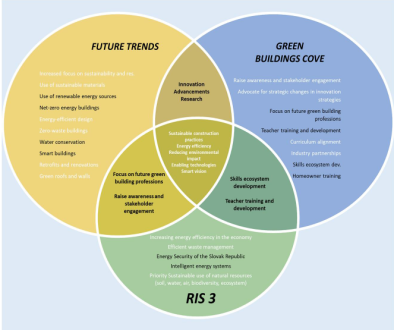
Building on the D3.1 Future Trends study on green construction, D3.2 set out Proposed Changes for the Attica region organised around enhanced collaboration between VET, industry, research and government; direct integration of the labour market with education; integration of green skills into curricula; strengthening skills for energy efficiency; and circular economy and IoT integration. It structured its future study guides around four pillars — Sustainable Energy, Circular Economy, Specialisation in RES & Sustainable Energy, and Collaboration with Industry Partners — and identified best CoVE practices including alignment with industry, modernisation of laboratories, innovative educational programmes, a culture of innovation and research, knowledge sharing, and teacher training.
Changes and additions at SAEK DELTA (2021–2025)
Course content within the national curricula >
SAEK DELTA’s technical branch delivers several of the nationally defined specialties that D3.2 identifies as central to the sustainable-energy and circular-economy transition. Within these specialties, SAEK DELTA has updated the delivered content of its modules to reflect the sustainable-energy and circular-economy priorities highlighted in D3.2. Specifically in the technical specializations of Automation Technician, Technician of Thermal Installations and Gas, Cooling Technician, Technician of Electrical Systems, Renewable Energy Sources Technician specific content was added, such as RES installation and maintenance, energy-efficiency practices, circular-economy principles, and introduction to IoT for energy monitoring, smart budlings and smart homes and green roofs.
This responds directly to D3.2’s recommendations on integrating green skills and strengthening skills for energy efficiency.
Digital and immersive delivery methods >
SAEK DELTA has introduced virtual reality (VR) learning modules and simulation-based training into its delivery, enabling trainees to practice installation, maintenance and safety procedures in a safe, repeatable digital environment. Specifically, SAEK DELTA introduced five modules: smart buildings, vegetated roofs, smart home, solar energy technics and green roofs, to the technical specializations mentioned above.
This operationalizes D3.2’s emphasis on digitalization and the “Digital Experience and IoT” requirement, and on modernizing laboratories to mirror real working conditions.
Cooperation with industry and improved work-based learning >
SAEK DELTA has deepened cooperation with industry partners and strengthened the internship and practical-training component, so that trainees gain experience aligned with real labour-market demand in the sustainable-energy sector, through the singing of more than 20 MoU with companies offering internships. This collaboration is across all qualifications offered and influenced by SECOVE project.
This reflects D3.2’s central recommendations on Enhanced Collaboration and Direct Integration of the Labour Market with Educational Institutions, in the same spirit as the SSPAE councils established under Law 4763/2020 to connect production and the labour market with VET.
Transnational mobility >
Through SECOVE and Erasmus+, SAEK DELTA has organized transnational mobility supporting the exchange of practice and exposure to sustainable-energy training approaches across European regions. Within the project duration, a group of nine students participated in transnational mobility. Furthermore, SAEK DELTA established MoU with 16 organizations in Spain, Portugal, Italy, Slovakia and other countries with the aim to further organize transnational work placements.
This supports D3.2’s conclusions on internationalization and cross-national cooperation.
Continuous professional development of trainers >
SAEK DELTA has invested in the continuous professional development of its trainers. SAEK DELTA’s trainers participated in the Training of Trainees course organized in Portugal.
This aligns with D3.2’s identification of teacher training as a key CoVE practice.
Contribution to the SECOVE KPI
These developments constitute a substantive update of SAEK DELTA’s training offer in terms of relevance and quality, achieved within the nationally defined syllabus. They map onto Greece’s RIS3 priorities in sustainable energy and the circular economy and onto the specific recommendations of D3.2. As such, they contribute to the KPI “Increasing the relevance and quality of VET curricula, according to Smart Specialization Strategies – Number of updated curricula”, with five curricula / specialties updated in their delivery, content and work-based learning components.
By concentrating on delivery methods, industry collaboration, digital and immersive tools, mobility and content enrichment, SAEK DELTA has aligned its provision with the sustainable-energy and circular-economy priorities of Greece’s Smart Specialization Strategy while respecting the national curriculum framework — demonstrating how a Greek CoVE partner can translate the recommendations of SECOVE D3.2 into concrete, measurable improvements to the quality and relevance of vocational training.